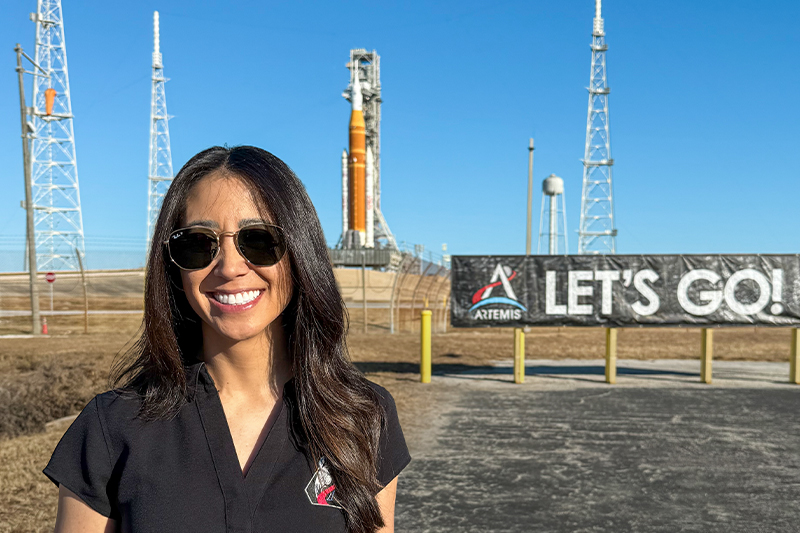
Stephanie Schulte (AAE’10) knew she was NASA-bound when her high school chemistry teacher gave her a copy of the book Failure Is Not an Option by Gene Kranz, the legendary NASA flight director whose leadership defined the golden age of American spaceflight.
“I fell in love with the excitement of space operations and the idea of working at NASA and in the Mission Control Center,” Schulte says. “I wanted to be at the center of all the action.”
As the flight operations manager for the Artemis program, that’s right where she is. Schulte’s role makes her an integral member of the historic Artemis II project—the initial crewed test flight in NASA’s effort to return humans to the vicinity of the moon for the first time in more than 50 years.
The Artemis II mission launched on April 1, 2026, and lasted for 10 days. During the flight, the crew of four astronauts ventured further into space than any humans had before, witnessing the lunar far side—a view lost to humanity since the end of the Apollo era.
“This was the most exciting thing I have ever been a part of,” Schulte says. “It was thrilling to be making history while also ushering in the new era of space exploration and development.”
Before launch, Schulte was responsible for ensuring the readiness of the astronauts and flight controllers—equipping them with essential tools and vehicle capabilities—and optimizing Mission Control for real-time response.
“The flight was designed to test out the human systems on the Orion spacecraft and our ability to send humans to the moon and return them safely after splashdown and recovery,” Schulte says. “It’s also a building block for the Artemis campaign, so we were looking to buy down risk for future human lunar landing and exploration missions.”
Purdue’s status as the “Cradle of Astronauts” began in the Mercury era with Virgil “Gus” Grissom (ME’50) and continues to grow today. Both the first and the most recent humans to walk on the moon were Boilermakers, and now a new generation—one that includes Schulte—is leading the way back.
A native of Freeport, Illinois, Schulte knew Purdue was for her after learning about the university’s historic ties to NASA’s Johnson Spaceflight Center in Houston. After touring campus, she was impressed by the facilities she’d be learning in and the opportunities she’d have to work closely with professors who played pivotal roles in sending spacecraft into deep space.
As a student, Schulte designed missions to other celestial bodies, designed and launched rockets, and learned the basic principles of craft design. She participated in a co-op program that allowed her to work frequently at the Johnson Space Center. She was also a member of the Students for the Exploration and Development of Space (SEDS) and the Purdue Space Day leadership team.
To this day, some of her most favorite memories include introducing children from the Greater Lafayette area to the excitement of space through experiments and meet-and-greet sessions with astronauts.
“I believe the spirit of exploration and discovery is something that lives in every child and adult,” Schulte says. “I love to connect that to the exciting things humans are doing in space to improve life for humanity.”
Immediately after graduating in 2010, Schulte accepted a position at NASA as a trajectory designer. She focused on reconstructing space shuttle ascent trajectories and designing abort trajectories for the Orion modules used during Artemis missions.
Schulte then transitioned to flight control and became a guidance, navigation, and control flight controller for the International Space Station—achieving her childhood dream of working in Mission Control—before taking her current position.
Schulte wears her Purdue lanyard every day at work. She also stays connected to the university through the Purdue Alumni Club of Houston and mentors recent Purdue graduates who work at NASA and share her drive to make an impact.
“I’m so fortunate to be surrounded by Purdue alumni in the astronauts, flight controllers, and leaders I work with—I always feel an instant bond when meeting them,” Schulte says. “Purdue’s space and exploration legacy will always have a special place in my heart. The Artemis campaign is built from that legacy and will use that foundation to create a sustainable infrastructure for lunar exploration that will change the world as we know it. It’s that mindset I learned at Purdue that makes this mission and this campaign so rewarding.”
—Keagan Slocum
“Victories & Heroes: Your Campaign for Purdue” is inspired by the powerful words of Purdue’s fight song, recognizing those who came before. If you have a Purdue hero in your life, we want to hear from you—share your story for an opportunity to be featured.
You can also contribute to the campaign today! Your investment will strengthen Purdue, elevate the university’s reputation, and expand opportunities for current and future Boilermakers.