Anything can happen when you’re thousands of feet above sea level on a mountain in a foreign country—and Beth (Schuessler) Nelson (P’87) is all too familiar with that uncertainty.
Just months after attempting to summit Mount Kilimanjaro, only to fall ill one day before the push to the top, an undaunted Nelson took on Mount Everest—and successfully reached one of the mountain’s highest destination points despite another bout of sickness.
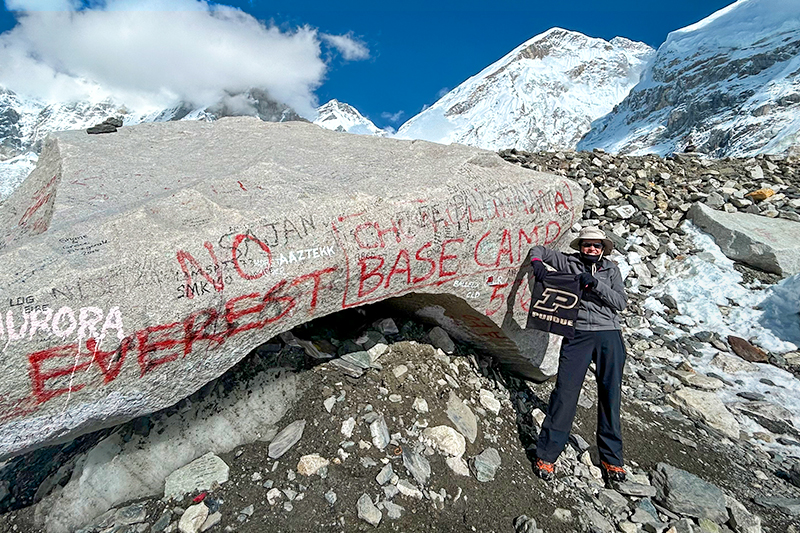
After ascending 17,598 feet up to Everest South base camp, where serious mountaineers often rest and acclimate before attempting to summit the tallest mountain in the world, Nelson commemorated the moment by holding up a Purdue flag and posing for a photo in front of the large landmark rock.
“I got emotional after getting my picture taken,” Nelson says. “I really wanted to prove to myself that I could do something completely out of the box. I would have been excited if I had summitted Kilimanjaro, but I think the disappointment of that experience made reaching base camp on Everest more emotional. I’d gone through ups and downs emotionally—not just elevation-wise—that made this experience more satisfying.”
In February 2025, Nelson’s husband, Mark (ECE’86), successfully summitted Kilimanjaro with a group of climbers from their local San Diego area, while Nelson was medically evacuated after developing a respiratory virus. But achieving great heights had been her idea in the first place.
“I hit a milestone birthday last year, so I was looking for something different to challenge me to get out of my comfort zone and mark the start of a new decade,” Nelson says. “After all the training we did for Kilimanjaro, it was so disappointing to get wiped out by a random respiratory virus. You may anticipate twisting an ankle or having altitude sickness, but I really didn’t see the virus coming.”
After that adventure, her local trek leader announced an October trip to Everest South base camp, and a third of the previous group’s hikers decided to join her once again. Like a true Boilermaker, Nelson was determined to take on a different mountain.
“This time, I wasn’t starting from zero and getting up to speed on the training,” Nelson says. “I felt stronger because I had already done the training for Kilimanjaro, came back, and decided a month or two later to begin training for Everest. I trained a little harder, so I felt good physically going into the trek.”
The Everest journey began with a flight from Kathmandu, Nepal, to Lukla, a small mountain town with no road access that is often called the gateway to South base camp. From there, the group—consisting of fellow San Diego-area hikers, their trek leader, two local Nepali guides, and porters who carried the heavy loads—set out on an 11-day adventure.
One of the big differences between Nelson’s two mountain journeys was the accommodations.
On Kilimanjaro, they set up camp in tents each night and cooked their own meals, so porters were responsible for carrying tents, sleeping bags, extra clothes, food, and other supplies. Along the Everest route, villages dotted the landscape, offering lodges known as tea houses where trekkers could spend the night and enjoy meals. These villages were home to Himalayan communities, though settlements became increasingly sparse and smaller as the group gained elevation.
Reaching South base camp didn’t come without its share of turmoil.
Days before the group traveled to Lukla, a storm stranded climbers on the mountain’s north side in Tibet and wiped out part of the trail to South base camp. Before the group even set out, a monkey attacked a fellow hiker visiting Swayambhunath—nicknamed the Monkey Temple—requiring rabies shots throughout the climb. Midway through the journey, a family emergency sent the trek leader back to the U.S. And along the way, altitude sickness knocked two more hikers out of the ascent.
Halfway through the ascent, Nelson had to deal with her own bout of unpredictability—she was hit with food poisoning. One of the guides stayed behind with her at a tea house while the others trekked ahead. After taking medicine and resting, Nelson mustered enough energy to meet up with the group at their next stop.
“I had different expectations since I knew I could do all of this again and something unexpected could come up—I was hoping lightning wouldn’t strike me twice, but I knew it could,” Nelson said. “I got really, really sick, and I could barely eat or drink anything for a couple days. People were asking me if I wanted to be evacuated, but some food poisoning wasn’t going to stop me. On Kilimanjaro, the respiratory virus was something I couldn’t handle at altitude, but I could push through the food poisoning. So, I kept going—and I’m glad I did.”
—Calandra Weaver
“Victories & Heroes: Your Campaign for Purdue” is inspired by the powerful words of Purdue’s fight song, recognizing those who came before. If you have a Purdue hero in your life, we want to hear from you—share your story for an opportunity to be featured.
You can also contribute to the campaign today! Your investment will strengthen Purdue, elevate the university’s reputation, and expand opportunities for current and future Boilermakers.